

Volcano Watching and Safety in Iceland - Your 2025-2026 Guide
Northern Lights, Lagoons & More
November 10, 2025
Volcano Watching and Safety in Iceland - Your 2025-2026 Guide
Northern Lights, Lagoons & More
November 10, 2025
In this article, we’ll share recent updates about the volcanic activity, take a deep dive into how it might impact travellers, discuss why you should consider taking an organised volcano tour with Reykjavik Excursions and explore the precautions you should take while near eruption sites. Volcano safety in Iceland is very much a priority, but so long as you follow official guidelines, it shouldn’t stop visiting with a reputable provider such as Reykjavik Excursions.
Is it possible to visit the Reykjanes volcanic area?
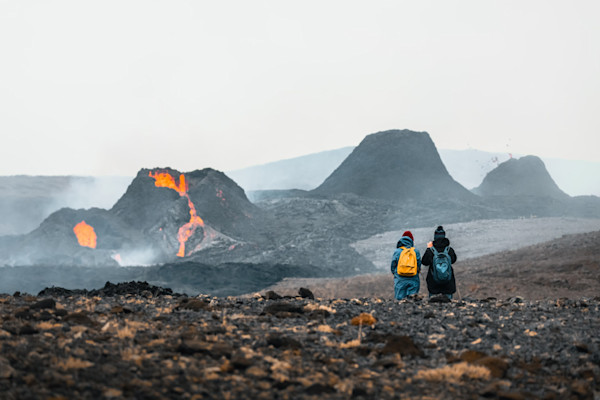
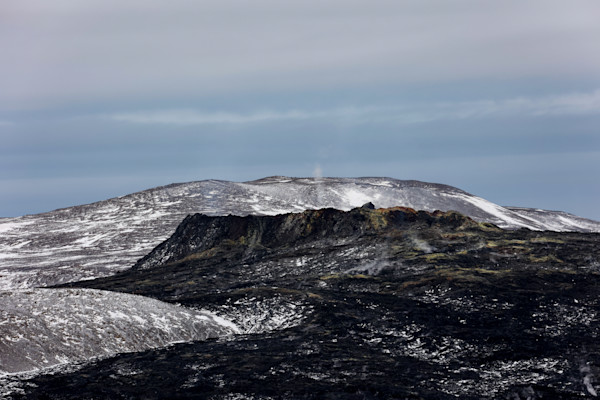
Volcanic activity in the Reykjanes peninsula kicked off in 2021 after a gap of some eight centuries. It captured the imagination of the world, flooding news outlets and social media feeds with stunning images of bountiful lava flows and magnificent craters. People hiked along the ridge to stare at the landscape resculpturing that was happening before their very eyes and rushed to book sightseeing flights for the ultimate airborne adventure. Later, volcanic activity shifted to the south west, opening up cracks in Grindavik and necessitating the evacuation of the iconic Blue Lagoon. The nature of the eruption got a little less predictable and while the authorities grappled with the problem, the public were understandably kept at arm’s length for their own safety. And so it has continued ever since, on and off. If you’re fascinated by such processes, that’s a good thing. During periods of access, the focus on volcano safety in Iceland and the associated caution showed by the relevant authorities has been reassuring. Iceland volcano tours have been carefully monitored and those excited at the prospect of visiting Iceland during eruptions can have confidence that decisions have been made to minimise risk. Our Volcanic Wonders with Grindavik Visit is an example of such tours that provide a window onto the events of the last few years. Accompanied by a knowledgeable guide, you’ll get a refresher on the events of the past few years as you combine a hike along the original eruption site to view Mount Fagradalsfjall with an eye-opening walk through Grindavik. You’ll have the opportunity to take in the still-warm lava field from a lofty overlook and see for your own eyes the berms and barriers that were constructed to hold back lava flows from people’s properties. The opportunity to learn about the long-lasting consequences of volcanic eruptions while within this once busy fishing port will make an indelible impression and give you a much deeper understanding of what happens than you’d ever be able to gain from the news headlines.
Practical information about our tour
Our tour is scheduled to operate three days a week throughout the year. However by its very nature, it is vulnerable to both inclement weather and any renewal of volcanic activity – the Reykjanes volcano eruptions are very much an ongoing event. In Grindavík too, volcano safety remains a priority and we reserve the right to cancel if conditions dictate. Nevertheless, this is a marvellous opportunity to really understand the processes that have shaped Iceland throughout the whole of its history. Whether you’re a first-time visitor or someone who’s returned to take a deeper dive into its unique landscapes, a trip to this area is a must. As the tour requires some physical activity in a challenging environment, the tour isn’t open to small children, but if you’re travelling with active over-tens it can be classed as family-friendly and likely to capture their imagination in a way no school lesson ever could. The Volcanic Wonders with Grindavik Visit is just one of a range of volcano-themed tours that we offer. Reykjanes is the obvious fit for those wondering how to visit an active volcano in Iceland. However, if it’s piqued your interest, venturing further into and even beyond the Reykjanes Global Geopark makes sense. Explore the country’s most impressive geothermal areas, combining sightseeing with a soak at one of Iceland’s famous lagoons. Step inside a lava tunnel or watch molten magma within the carefully controlled setting of LAVA Show in Reykjavik or Vik. For the ultimate thrill, consider our Volcano Hat Trick: a super jeep adventure that combines Hekla, Kerið crater and Stóra Eldborg volcano. It’s proof that Iceland volcano tours really are as diverse as they are fascinating.
How safe is it to visit active volcanoes in Iceland?
There’s no straightforward answer to a question about volcano safety in Iceland, except to say that no volcano can ever be considered 100% safe to visit. What you can do, however, is gather enough data to make an informed decision about the level of risk to allow you to figure out whether you personally are happy to venture into an area of volcanic activity or not.
No volcanic eruption can ever be predicted with absolute certainty. However, in some cases, lava can be slow flowing or take fairly predictable routes as it flows out of the crater. Compared to explosive volcanic eruptions which create pyroclastic flows and throw out massive chunks of rocks, these slow-moving lava flows can sometimes be viewed at a relatively close distance, as was the case with the Mount Fagradalsfjall eruptions in 2021 and 2022.
The Icelandic authorities monitor the country’s volcanic systems with meticulous care. Scientists study measurements involving the lava’s geological composition, gas emissions, magma chamber, topography changes, earthquakes and other data in order to piece together a clearer picture of what’s happening beneath the earth’s surface.
In some cases, the authorities order evacuations; in others, people are able to legally hike to the edge of the lava. Even where lava has cooled and a solid, blackened crust has formed on the top of the flow, it isn’t safe to walk on. What appears to be hard can be very fragile, unable to take the weight of a person.
Falling through can have tragic, life-altering consequences. Indeed, you might not live to tell the tale. Taking a chance with your life in such a way is not only reckless but it can also endanger the lives of those who’d be tasked with your rescue. Taking an organised tour with a competent guide who’s abreast of the current situation can give you the reassurance that you are in capable hands and won’t unwittingly venture into a risk-prone area.

How do you stay up to date about volcanic activity during your trip?
One of the exciting yet worrisome aspects about volcanic activity is how quickly the situation can change. Unless you’re an expert in the field, this means that you are reliant on up to date advice about the nature of any volcanic eruption and the areas that such activity affects. Yet the internet is awash with misinformation, not least on social media where posts may convey news and pictures that are incorrect. One of the easiest ways you can stay up to date is by checking the updates that are posted on the website of the Icelandic Meteorological Office. There’s a section dedicated to the country’s volcanoes and, when there’s an ongoing burst of activity, the ticker will display a headline and link to the current news story. You’ll also find information about gas levels and air quality on this site. The wind direction can also play a significant role in determining whether an area can be safely visited, for instance, if the volcanic gases are being blown out to sea and have dispersed from areas where people might be keen to hike. Information about safe volcano viewing in Iceland can also be found online at Safe Travel, a website that invites you to submit trip plans if travelling independently. The site has a dedicated page for the Reykjanes eruption that you can refresh during your stay. Further information is published by the Government of Iceland and also Visit Iceland. There is an abundance of resources so there’s no excuse not to be fully briefed on Iceland volcanic activity in 2025 as you prepare for your holiday. You can also opt to follow an Icelandic news outlet on social media for updates on volcanic activity in general. One of the most straightforward for overseas visitors is RUV which posts regularly, covering important news stories in English. Alternatively, for the latest on the Mount Fagradalsfjall and Sundhnúkur eruptions, check dated articles posted by Visit Reykjanes. One thing you’ll most probably not have to worry about is the impact on Keflavik Airport. Unlike in 2010, when the ash cloud resulting from Eyjafjallajökull’s eruption caused significant disruption to global air traffic, the current series of eruptions on Reykjanes hasn’t had the same effect. Though Keflavik has been shut temporarily as a precaution to allow the authorities to determine that there’s no risk to arriving or departing aircraft, a prolonged closure has not been necessary thus far.

Iceland volcano travel tips
Reserve your place on a tour early in your trip
Volcanic activity ebbs and flows. The current eruption in Reykjanes is no different and phases of intense activity have been interspersed with lulls. To maximise your chance of being able to join a tour, we’d recommend you slot it into your itinerary early on in case of a postponement caused by poor weather or a change in volcanic activity levels.
Dress appropriately for the environment you’ll be in
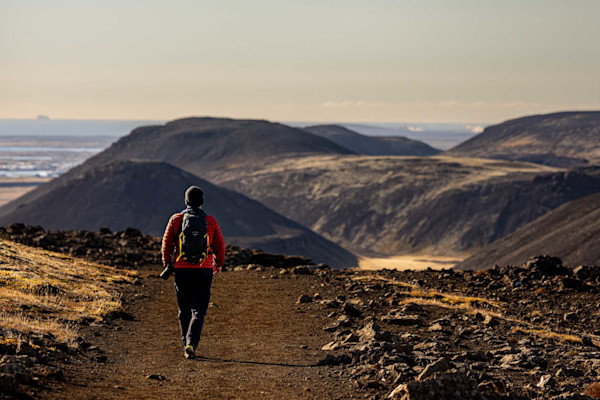
Hiking up to the volcano viewpoint requires a common sense approach. You’ll need to have sturdy hiking boots that have been broken in; walking poles and, when icy, crampons can be invaluable in helping you to stay upright on sloping or slippery parts of the trail. As with anywhere in Iceland, the weather can be unpredictable, so for your own comfort be sure to dress in cosy layers and remember that the top one should be wind- and waterproof. Don’t forget a hat, gloves and warm socks.
Other gear you should bring for volcano watching in Iceland
The landscape that you’ll find yourself in is likely to have you reaching for your camera, so make sure you have a fully charged battery and plenty of storage space. In winter, the cold can drain a battery quicker than you might think so keep a spare tucked within an inside pocket where your body heat will help to keep it warm. If you’re keen to discover how a recent eruption has altered the landscape and created lasting repercussions for those who live in its shadow, then we’d urge you to join our Volcanic Wonders with Grindavík Visit. Perhaps instead you’re interested in setting foot inside a cooled lava tube or simply wish to get close enough to recreated lava to feel the intense heat? Then, you might wish to join one of our other many and varied volcano tours. However you incorporate it into your Iceland itinerary, the chance to experience what volcanoes do is one you shouldn’t pass up.
Tours in the spotlight


REYKJAVIK EXCURSIONS BLOG
Get inspired by our blog! Information and tips and must see places in Iceland, fun facts, customs and more.


The Silver Circle of West Iceland - Your Guide
You’ve heard of the Golden Circle, but here’s why you should head to Iceland’s western region to explore the msytical Silver Circle tour route.
Read BlogVolcano Watching and Safety in Iceland - Your 2025-2026 Guide
Northern Lights, Lagoons & More
November 10, 2025
Volcano Watching and Safety in Iceland - Your 2025-2026 Guide
Northern Lights, Lagoons & More
November 10, 2025
In this article, we’ll share recent updates about the volcanic activity, take a deep dive into how it might impact travellers, discuss why you should consider taking an organised volcano tour with Reykjavik Excursions and explore the precautions you should take while near eruption sites. Volcano safety in Iceland is very much a priority, but so long as you follow official guidelines, it shouldn’t stop visiting with a reputable provider such as Reykjavik Excursions.
Is it possible to visit the Reykjanes volcanic area?
Volcanic activity in the Reykjanes peninsula kicked off in 2021 after a gap of some eight centuries. It captured the imagination of the world, flooding news outlets and social media feeds with stunning images of bountiful lava flows and magnificent craters. People hiked along the ridge to stare at the landscape resculpturing that was happening before their very eyes and rushed to book sightseeing flights for the ultimate airborne adventure. Later, volcanic activity shifted to the south west, opening up cracks in Grindavik and necessitating the evacuation of the iconic Blue Lagoon. The nature of the eruption got a little less predictable and while the authorities grappled with the problem, the public were understandably kept at arm’s length for their own safety. And so it has continued ever since, on and off. If you’re fascinated by such processes, that’s a good thing. During periods of access, the focus on volcano safety in Iceland and the associated caution showed by the relevant authorities has been reassuring. Iceland volcano tours have been carefully monitored and those excited at the prospect of visiting Iceland during eruptions can have confidence that decisions have been made to minimise risk. Our Volcanic Wonders with Grindavik Visit is an example of such tours that provide a window onto the events of the last few years. Accompanied by a knowledgeable guide, you’ll get a refresher on the events of the past few years as you combine a hike along the original eruption site to view Mount Fagradalsfjall with an eye-opening walk through Grindavik. You’ll have the opportunity to take in the still-warm lava field from a lofty overlook and see for your own eyes the berms and barriers that were constructed to hold back lava flows from people’s properties. The opportunity to learn about the long-lasting consequences of volcanic eruptions while within this once busy fishing port will make an indelible impression and give you a much deeper understanding of what happens than you’d ever be able to gain from the news headlines.
Practical information about our tour
Our tour is scheduled to operate three days a week throughout the year. However by its very nature, it is vulnerable to both inclement weather and any renewal of volcanic activity – the Reykjanes volcano eruptions are very much an ongoing event. In Grindavík too, volcano safety remains a priority and we reserve the right to cancel if conditions dictate. Nevertheless, this is a marvellous opportunity to really understand the processes that have shaped Iceland throughout the whole of its history. Whether you’re a first-time visitor or someone who’s returned to take a deeper dive into its unique landscapes, a trip to this area is a must. As the tour requires some physical activity in a challenging environment, the tour isn’t open to small children, but if you’re travelling with active over-tens it can be classed as family-friendly and likely to capture their imagination in a way no school lesson ever could. The Volcanic Wonders with Grindavik Visit is just one of a range of volcano-themed tours that we offer. Reykjanes is the obvious fit for those wondering how to visit an active volcano in Iceland. However, if it’s piqued your interest, venturing further into and even beyond the Reykjanes Global Geopark makes sense. Explore the country’s most impressive geothermal areas, combining sightseeing with a soak at one of Iceland’s famous lagoons. Step inside a lava tunnel or watch molten magma within the carefully controlled setting of LAVA Show in Reykjavik or Vik. For the ultimate thrill, consider our Volcano Hat Trick: a super jeep adventure that combines Hekla, Kerið crater and Stóra Eldborg volcano. It’s proof that Iceland volcano tours really are as diverse as they are fascinating.
How safe is it to visit active volcanoes in Iceland?
There’s no straightforward answer to a question about volcano safety in Iceland, except to say that no volcano can ever be considered 100% safe to visit. What you can do, however, is gather enough data to make an informed decision about the level of risk to allow you to figure out whether you personally are happy to venture into an area of volcanic activity or not.
No volcanic eruption can ever be predicted with absolute certainty. However, in some cases, lava can be slow flowing or take fairly predictable routes as it flows out of the crater. Compared to explosive volcanic eruptions which create pyroclastic flows and throw out massive chunks of rocks, these slow-moving lava flows can sometimes be viewed at a relatively close distance, as was the case with the Mount Fagradalsfjall eruptions in 2021 and 2022.
The Icelandic authorities monitor the country’s volcanic systems with meticulous care. Scientists study measurements involving the lava’s geological composition, gas emissions, magma chamber, topography changes, earthquakes and other data in order to piece together a clearer picture of what’s happening beneath the earth’s surface.
In some cases, the authorities order evacuations; in others, people are able to legally hike to the edge of the lava. Even where lava has cooled and a solid, blackened crust has formed on the top of the flow, it isn’t safe to walk on. What appears to be hard can be very fragile, unable to take the weight of a person.
Falling through can have tragic, life-altering consequences. Indeed, you might not live to tell the tale. Taking a chance with your life in such a way is not only reckless but it can also endanger the lives of those who’d be tasked with your rescue. Taking an organised tour with a competent guide who’s abreast of the current situation can give you the reassurance that you are in capable hands and won’t unwittingly venture into a risk-prone area.
How do you stay up to date about volcanic activity during your trip?
One of the exciting yet worrisome aspects about volcanic activity is how quickly the situation can change. Unless you’re an expert in the field, this means that you are reliant on up to date advice about the nature of any volcanic eruption and the areas that such activity affects. Yet the internet is awash with misinformation, not least on social media where posts may convey news and pictures that are incorrect. One of the easiest ways you can stay up to date is by checking the updates that are posted on the website of the Icelandic Meteorological Office. There’s a section dedicated to the country’s volcanoes and, when there’s an ongoing burst of activity, the ticker will display a headline and link to the current news story. You’ll also find information about gas levels and air quality on this site. The wind direction can also play a significant role in determining whether an area can be safely visited, for instance, if the volcanic gases are being blown out to sea and have dispersed from areas where people might be keen to hike. Information about safe volcano viewing in Iceland can also be found online at Safe Travel, a website that invites you to submit trip plans if travelling independently. The site has a dedicated page for the Reykjanes eruption that you can refresh during your stay. Further information is published by the Government of Iceland and also Visit Iceland. There is an abundance of resources so there’s no excuse not to be fully briefed on Iceland volcanic activity in 2025 as you prepare for your holiday. You can also opt to follow an Icelandic news outlet on social media for updates on volcanic activity in general. One of the most straightforward for overseas visitors is RUV which posts regularly, covering important news stories in English. Alternatively, for the latest on the Mount Fagradalsfjall and Sundhnúkur eruptions, check dated articles posted by Visit Reykjanes. One thing you’ll most probably not have to worry about is the impact on Keflavik Airport. Unlike in 2010, when the ash cloud resulting from Eyjafjallajökull’s eruption caused significant disruption to global air traffic, the current series of eruptions on Reykjanes hasn’t had the same effect. Though Keflavik has been shut temporarily as a precaution to allow the authorities to determine that there’s no risk to arriving or departing aircraft, a prolonged closure has not been necessary thus far.
Iceland volcano travel tips
Reserve your place on a tour early in your trip
Volcanic activity ebbs and flows. The current eruption in Reykjanes is no different and phases of intense activity have been interspersed with lulls. To maximise your chance of being able to join a tour, we’d recommend you slot it into your itinerary early on in case of a postponement caused by poor weather or a change in volcanic activity levels.
Dress appropriately for the environment you’ll be in
Hiking up to the volcano viewpoint requires a common sense approach. You’ll need to have sturdy hiking boots that have been broken in; walking poles and, when icy, crampons can be invaluable in helping you to stay upright on sloping or slippery parts of the trail. As with anywhere in Iceland, the weather can be unpredictable, so for your own comfort be sure to dress in cosy layers and remember that the top one should be wind- and waterproof. Don’t forget a hat, gloves and warm socks.
Other gear you should bring for volcano watching in Iceland
The landscape that you’ll find yourself in is likely to have you reaching for your camera, so make sure you have a fully charged battery and plenty of storage space. In winter, the cold can drain a battery quicker than you might think so keep a spare tucked within an inside pocket where your body heat will help to keep it warm. If you’re keen to discover how a recent eruption has altered the landscape and created lasting repercussions for those who live in its shadow, then we’d urge you to join our Volcanic Wonders with Grindavík Visit. Perhaps instead you’re interested in setting foot inside a cooled lava tube or simply wish to get close enough to recreated lava to feel the intense heat? Then, you might wish to join one of our other many and varied volcano tours. However you incorporate it into your Iceland itinerary, the chance to experience what volcanoes do is one you shouldn’t pass up.
Tours in the spotlight
REYKJAVIK EXCURSIONS BLOG
Get inspired by our blog! Information and tips and must see places in Iceland, fun facts, customs and more.
The Silver Circle of West Iceland - Your Guide
You’ve heard of the Golden Circle, but here’s why you should head to Iceland’s western region to explore the msytical Silver Circle tour route.
Read Blog